Fatty Acid Synthesis: Activation, Steps and Control
Fatty acid synthesis occurs similarly to Beta-oxidation – acetyl groups are added to a growing chain, but the mechanism of the pathway is distinctly different from being simply the reverse of Beta-oxidation.
Fatty acid synthesis occurs in the cytosol (not mitochondria). It uses a moiety called Acyl-carrier protein (ACP) instead of CoA and the reducing agent NADPH (not NAD/FAD). It will be noted that there are structural similarities between the Coenzyme A portion of CoA and the Phosphopantetheine moiety of ACP.
The reaction has a different stereochemisry from Beta-oxidation and the form of the unit added is actually a three carbon unit (malonyl-CoA) which is decarboxylated to incorporated a net 2 carbon unit. As we shall see, fatty acid biosynthesis can be broken in to three separate pathways shown below:

Transport of Mitochondrial Acetyl-CoA into the Cytosol
Acetyl-CoA is produced in two ways in the mitochondria –
- by Beta-oxidation of fatty acids, and
- by combined action of pyruvate dehydrogenase (to decarboxylate pyruvate, producing acetate) and dihydrolipoyl transacetylase (to add the CoA to the acetate).
Acetyl CoA will accumulate when the ETS/oxidative phosphorylation slows (why? – a good exam question).
Under these conditions, acetyl-CoA is transported out of the mitochondrion to the cytosol where it can be used in fatty acid synthesis. This is accomplished using the tricarboxylate transport system in the inner mitochondrial membrane which pumps citrate out

Acetyl-CoA, of course is used in synthesis of citrate when combined with oxaloacetate. Citrate transferred into the cytosol is broken back to oxaloacetate and acetyl-CoA by ATP-citrate lyase(using ATP and CoA). Oxaloacetate can be reduced to malate by malate dehydrogenase and NADH. Malate can be converted to pyruvate by malic enzyme and NADP+.
The resulting pyruvate is permeable to the inner mitochondrial membrane and diffuses in. Inside the mitochondrion, pyruvate can be converted to oxaloacetate by pyruvate carboxylase (along with bicarbonate ion, and ATP), completing the cycle.
An alternative path is to transport malate across the inner membrane and convert it to oxaloacetate.
Fatty acid Synthesis Mechanism:
Acetyl-CoA Carboxylase:
The first committed step of fatty acid biosynthesis is catalyzed by Acetyl-CoA carboxylase. The enzyme contains biotin, and adds a CO2 (resulting in a carboxyl group) to the methyl end of acetyl CoA. Note that this reaction is an energy requiring process (1 ATP per Malonyl-CoA formed).
Acetyl-CoA carboxylase is an interesting enzyme. Studies of the enzyme from birds and mammals indicate that it forms long linear polymers. The polymer appears to be the active form of the enzyme. Monomeric units are inactive. Citrate shifts the polymer – monomer equilibrium towards polymer formation.
Palmitoyl-CoA shifts the equilibrium towards monomer formation. Of the two compounds affecting enzyme form, palmitoyl-CoA probably exerts the greater influence.

Another regulation of Acetyl-CoA carboxylase is by hormones. Glucagon, epinephrine, and norepinephrine trigger a cAMP dependent phosphorylation (remember the cascade system) of the enzyme that shifts the equilibrium towards monomer formation. Insulin, conversely, stimulates desphosphorylation, favoring polymerization.
The enzymes responsible for phosphorylating Acetyl-CoA carboxylase are cAMP-dependent protein kinase and AMP-dependent protein kinase (AMPK). E. coli’s Acetyl-CoA carboxylase is regulated by guanine nucleotides, which are a function of those cells’ growth requirements.
Fatty Acid Synthase Complex
This multifunctional enzyme catalyzes the seven different reactions whereby two carbon units from malonyl-CoA are linked together, ultimately to form palmitoyl-CoA. In some systems, the activities are present on separate enzyme units.
In other cells, a single polypeptide chain has multiple activities that can be isolated after protease treatment. The enzyme complex can exist as both a monomer and dimer. The dimeric form is the fully functional form of the enzyme. The overall synthesis of palmitate from acetyl-CoA requires 14 NADPHs, and 7 ATPs.
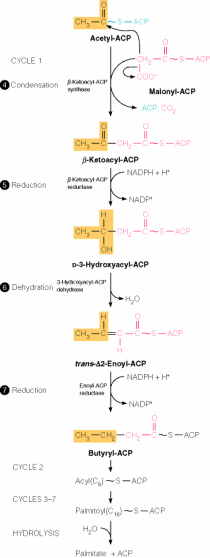
Steps of fatty acid synthesis starting with Acetyl-CoA and Malonyl-CoA are shown in in the given Figure.
The reactions are as follows:
- Transfer of the malonyl group of malonyl-CoA to ACP (Reaction #2 – catalyzed by malonyl-CoA-ACP transacylase). Transfer of the acetyl group of Acetyl-CoA to ACP (Reaction #3 of – catalyzed by acetyl-CoA-ACP transacylase).
- Addition of an acetyl group from malonyl-ACP between the thioester bond of the acetyl-ACP molecule in reaction 1 (Reaction 4 of – catalyzed by Beta-keto-ACP synthase – also called condensing enzyme).
- Reduction of the Beta-keto group to a Beta-hydroxyl group with NADPH (Reaction 5 of – catalyzed by Beta-keto-ACP reductase).
- Dehydration between the alpha and Beta carbons (Reaction 6 of – catalyzed by Beta-hydroxyacyl-ACP dehydrase).
- Reduction of the trans double bond by NADPH (Reaction 7 of – catalyzed by enoyl-ACP reductase).
- Repetition of steps 2-6 six more times. The acetyl group of reaction 1 is replaced by the growing acyl-ACP molecule. (That is, new acetyl groups are added at the ACP end of the molecule).
- The product of this series of reactions, palmitoyl-ACP can be cleaved to palmitate and ACP by the enzyme palmitoyl thioesterase.
The multiple enzymatic activities integrated into Fatty Acid Synthase complex are probably related to the growing fatty acid being “swung” into the appropriate catalytic region of the synthase.

Elongation of Palmitate:
The product of fatty acid synthase action, palmitate, is but of course one of many fatty acids synthesized by cells. Elongases are enzymes that act to lengthen palmitateto produce many of the other fatty acids. Elongases are present in mitochondria and the endoplasmic reticulum. Elongation using elongase in the mitochondrion involves a mechanism that is essentially the reverse of Beta-oxidation except substitution of NADPH for FADH2 in the last reaction.
Desaturation of Fatty Acids:
Terminal desaturases produce unsaturated fatty acids. One such enzyme is fatty acyl-CoA desaturase. Note the unusual electron transferring pathway in which electrons from NADH are ultimately passed to oxygen, forming water.
The energy released in this process drives oxidation of stearoyl-CoA to oleyl-CoA. From the free methyl end, mammals cannot make double bonds closer to the end than the Delta-9 position (Oleic acid is a Delta-9 fatty acid). Thus, linoleic acid (Delta 9,12 double bonds) and linolenic acid (Delta 9,12,15 double bonds) must be provided in the diet of mammals, and are called essential fatty acids


Comments
Post a Comment